Investment thesis

Robert Half International RHI has a strong brand reputation offering diversified services and has strong free cash flows. However, the company is facing macroeconomic and structural headwinds in the US. RHI’s multi-segment strategy specially Protiviti is well known that provides HR and recruitment consulting to large corporations. Historically, the company has been able to successfully deal with volatility in job market and meet the staffing demands for its clients.
Over the years, RHI has maintained a very negligible level of debt and has consistently bought back shares. The nature of its business is cyclical therefore, its currently in a downcycle and hence its revenues and earnings have a declining trend since 2022 affected by Covid-19 pandemic and high interest rates.
RHI’s business has been affected due to an economic slowdown in the US whereby new hiring is still lower, and rising competition and technological disruptions have significantly affected its business. Despite all these challenges the company has still been able to generate and grow free cash flows at a modest CAGR of 2.5%. Based on our DFCF valuation the company’s fair value is estimated to be $44.52 per share indicating that the company is trading at its fair value. However, for long term investors who can wait the company might be able to offer greater value once the macro conditions stabilize and the company move to an upcycle.
 
Company overview
Robert Half Inc (RHI) is one of the top international staffing companies in the US and the UK providing expert staffing services to different industries. RHI was founded in 1948 and since then it has established a great reputation for providing highly qualified staff to different sectors with appropriate career opportunities. The company provides complete staffing solutions including projects, temporary placements and permanent. The company operates in more than 300 locations internationally. It has clientele that includes small and medium sized businesses as well as fortune 500 companies. RHI’s commitment to quality training and sourcing quality staff is reflected through its client satisfaction as a result of high moral and ethical standards, and knowledge and skills of the staff sourced through them.
 
Business model
RHI provides staffing and consulting services. It caters to businesses that hire professionals. Its revenue is based on a placement fee. It charges a fee to employers for successfully placing temporary or permanent staff on the basis of a contract and the company generates its revenue through hourly markups and earns margins on its billable hours to corporations. RHI also provides consulting and risk advisory services in areas like technology, finance and corporate governance and charges a fee for such specialized services.
 
Operating segments
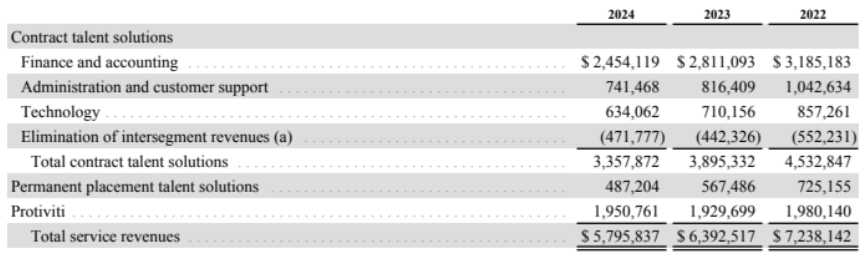
Contract talent solution: This segment is also known as “temporary and consulting staffing” offering contracts and temporary professionals in a variety of fields such as finance, accounting, IT, marketing and administrative support. The revenue from this segment declined from $3.89 billion in 2023 to $3.36 billion in 2024, In Q2 2025 revenue generated for this segment was $759.81 million Permanent placement talent solutions:
This segment provides full-time hiring for various positions in financing and accounting, IT and administration. However, revenue from this segment dropped from $567 million in 2023 to $487 million in 2024 representing a decline of 14.11% attributed to the ongoing macroeconomic uncertainty. As a consequence, most companies that RHI caters to became more selective and either slowed down or completely cut their permanent hiring for now. This segment generated a revenue of $114.71million in Q2 2025.
Source: Company’s Annual Report (10K)
Protiviti: This division provides internal audit, risk advisory and consulting services under its Protiviti brand. The services cover a wide range of industries including technology, finance governance, cyber security and compliance. The revenue from this segment slightly increased growing at a modest 1% in 2024 from $1.92 billion in 2023 vs $1.95 billion in 2024. In Q2 2025 the revenue generated was $495.22 million.
 

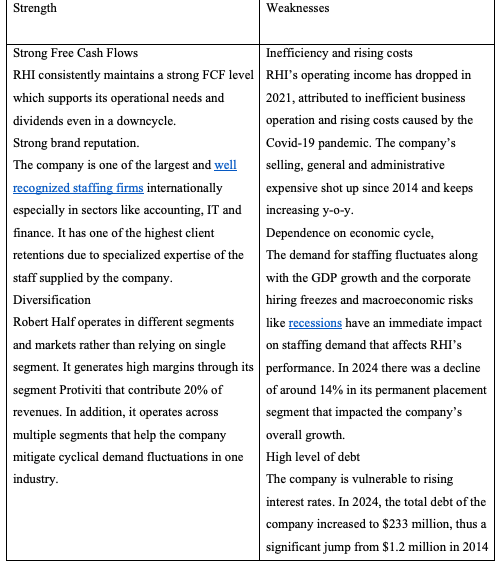
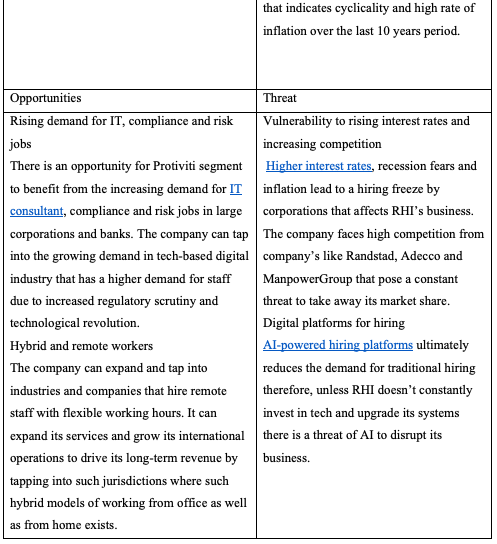
SWOT ANALYSIS

Financial performance analysis

Revenue
RHI’s revenue increased from $4.7 billion in 2014 to $5.8 billion in 2024 with a CAGR of 2.1% indicating a compound annual growth the company reported $5.5 billion in 2025 (TTM), however revenue peaked at $7.2 billion in 2022 before declining in recent years.
 
Debt
RHI’s total debt increased sharply from $1.3 million in 2014 to $233.5 million in 2024 and $243 million in 2025 (TTM) indicating a higher leverage. Its long-term debt jumped from $1.16 Million 2014 to $168.9 million 2024. In 2025 (TTM) its long-term debt stands at $174 million.
In the last 10 years, between 2014 to 2025, RHI’s debt-to-equity rose from 0.68 to 1.16 suggesting a gradual shift towards higher leverage. However, it stayed under 0.7 until 2017 but jumped to 1.0 between 2019-2021 then dipped slightly between 2022 and 2023 and hit a decade high in Q2, 2025 (TTM). This suggests greater reliance on debt for its business sustainability and growth.
 
Net Income
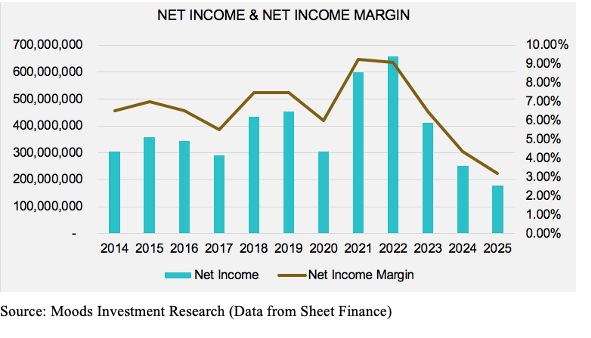
RHI’s net income fluctuated over the last 10 years period from $305.9 million in 2014 to $251.6 million in 2024. In 2025 (TTM) it earned $178 million. Its net income peaked at $657.9 million in 2022 before declining to $411.1 million in 2023.The net profit declined due to economic slowdown, rising costs such as operational expenses, and debt interest payments as a result of high interest rates.

RHI’s net income margin also fluctuated over the last 10 years period from 6.52% in 2014 to 4.36% 2024 and then further declined 3.18% in 2025 (TTM).  It peaked at 9.26% in 2021 and 9.09% in 2022 before declining in recent years.

 
Free Cash Flow (FCF)
RHI’s free cash flows grew from $277.9 million in 2014 to $354.2 million in 2024. In 2025 (TTM) it had FCF of $285 million. The company generated the highest FCF in 2022 of $622.6 million growing at a CAGR of 2.5% indicating a period of modest growth. Moreover, its FCF in 2022 immediately after the Covid-19 pandemic and economic recovery was almost doubled due to strong demand for staffing and consulting services. However, since then FCF fell by approximately 43% from its peak due to a rise in interest rates. The 10-year CAGR indicate modest long-term growth but last few years show a downward trend pointing at sluggish market condition and operational challenges affecting RHI’s business.
 
Other metrics
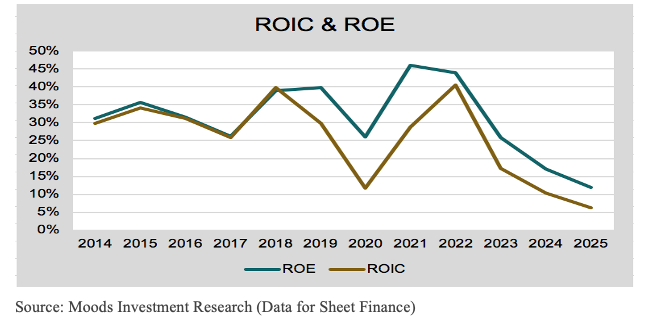
RHI’s return on equity (ROE) Dropped from 31% in 2014 to 16.96% in 2024. In 2025 (TTM) it decreased to 12.8%. Its return on invested capital (ROIC) decreased from 30% in 2014 to 9.71% in 2024 and then further dropped to 6.25% in 2025 (TTM) thus indicating lower return on invested capital.

Share Buybacks

In Q1 2025 (TTM) the company repurchased approximately 650,000 shares and in Q2 2025 RHI bought back 450,000 shares at a cost of about $20 million. Prior to this, the company actively repurchased 3.5million shares in 2024 for $249million. The weighted average diluted shares outstanding decreased from 135.5 million in 2014 to 103 million in 2024, and 101 million in 2025 (TTM) thus reflecting a 2.8% reduction annually. Therefore, this reduction of approximately $32 million shares helped the earning per share grow despite declining revenues.
 

Fair value

Based on the last 10 years free cash flows discounted at 12% the intrinsic value of RHI is $44.52 per share indicating that the stock is trading close to its fair value with no margin of safety or upside potential in the short term. However, in the long term the company is expected to offer more value if interest rates are reduced further and the economy continues to recovers.
 
Catalyst
The CEO Keith Waddell stated “We believe in technology. We believe in AI” the company is now focusing more on technology and AI to enhance service offerings and create future opportunity. Their consulting arm Protiviti has a strong demand overseas, especially in areas like risk, digital transformation project and compliance, Protiviti consulting, contract staffing bill rates are up by about 4% y-o-y. Despite slower hiring market, the company’s consulting arm Protiviti, is growing internationally. The company is saving up to $80 million annually which will help them improve their margins and make up for lower sales.
In addition, the company’s consistent buybacks and dividend increases have improved its EPS. In Q3, 2025 its revenue is expected to be in the range of $1.31B to $1.41B, and operating income is projected to rise sequentially. RHI’s management is cautiously optimistic about the demand for staffing although still lower but it’s starting to stabilize.
 
Key risk factors for RHI’s business
The company’s performance is highly sensitive to the global economic conditions, reflected in a decline in its revenues between 2023 and 2024. Its vulnerable to high interest rates that effect employment and weakens hiring activity in corporations. High inflation caused by higher tariffs in the US and other geopolitical tensions affect RHI’s business negatively. RHI faces high competition from companies like Randstad, ManpowerGroup and Adecco and also from digital recruitment platforms like LinkedIn that threaten and reduce the pricing power, market share and margins of RHI.
In addition, working across various jurisdictions exposes the company to tax, and other legal and labor risks. Any regulatory changes also affect RHI’s business and could damage its reputations because of noncompliance and penalties. Various digital hiring platforms and AI-driven hiring tools like Torre.ai, Hire Vue, challenge the company’s traditional model. A lower demand for temporary staff during the downturns also causes a declined in RHI’s revenues. Its Protiviti segment might face lawsuits from advisory work especially in high risk areas like cybersecurity and compliance which could lead to reputational damage and potential financial loss. Pandemics such as Covid-19 or wars disturb the hiring activities and
labor markets which directly affect RHI’s revenue due to a lower demand and hiring of staff by multinational companies.
 
Conclusion
Robert Half has a strong operating history and brand equity and the company has maintained a financial discipline through lower leverage historically. However, in recent years its business has been affected by the pandemic and slower economic growth. Despite these challenges the company is consistently buyback and reducing its shares. In the last few years, there has been a decline in RHI’s revenues and earnings due to shifting hiring trends and a slower global economy as a result of rising interest rates.
RHI depends on the economic cycle and is facing high competition from digital hiring platforms. However, despite these challenges its Protiviti segment could help to get through a downturn. Investors should monitor the macroeconomic indicators and RHI’s tech adoption strategy. Overall, the company has a hold rating and there could be value for investors who are patient and can wait for the economic recovery and the company moving to an up cycle in the medium to long term.
 

Disclaimer

This report is for informational purposes only and does not constitute investment advice, nor is it an offer to buy or sell any securities. Moods Investment Research and its Directors do not hold a position in RHI at the time of publishing this report. Investors are strongly encouraged to conduct their own analysis and due diligence before making any investment decisions. The information presented is based on data available on the day its published, and future performance may vary due to market conditions, economic factors, or other unforeseen events.


Leave a Reply

Your email address will not be published. Required fields are marked *

Important Disclosure

Moods Investment Research is an investment research and financial education company registered in Ontario, Canada. We do not operate as an investment advisory firm, which means we are not a registered broker, dealer, or investment fund.

Any information shared on Moods Investments’ websites or YouTube channels should not be considered a recommendation to buy or sell any security. The content provided is for informational and educational purposes only and does not constitute investment advice. We do not express opinions on the future prices of securities, nor do we provide specific guidance for individual investment decisions.

Documents and reports on this site are not classified as investment research under OSC regulations, which are designed to promote independent research. Even if certain materials contain research-based recommendations, they should be treated as marketing communications. As such, they are presented in a fair, clear, and non-misleading manner, in line with OSC rules. Please note that these communications are not personal investment recommendations, and any opinions expressed may change without notice.

We strongly encourage investors to conduct their own independent research and due diligence using publicly available information rather than relying solely on the content found on this website. Our materials are not intended to suggest or dictate which securities to buy or sell. Additionally, analysts, employees, or affiliates of Moods Investments Inc. may hold positions in the securities or industries discussed. Please be aware that investing in securities carries a high degree of risk.

Moods Investments (MI) and Moods Investment Research are not liable for any damages arising from the use of content published on our websites or YouTube channels. This includes, but is not limited to, investment losses, lost profits, lost opportunities, or any indirect, incidental, or consequential damages. Past performance is not a reliable indicator of future results.

The information provided on this site and our channels is not guaranteed for completeness, accuracy, or timeliness. Moods Investment Research Inc. offers third-party financial data, investment research, and financial analysis. We also provide self-paced, web-based courses on financial analysis and investing for educational purposes only.

Use of links to other websites

For your convenience, Moods Investment Research may provide links to third-party websites and service providers. However, we are not responsible for any errors, omissions, or inaccuracies in the content found on those external sites. Additionally, we do not necessarily endorse or approve the information provided by third parties.

Users who access third-party websites should be aware that those sites may have their own copyright policies and usage restrictions.

By using this website, you agree to our use of cookies. We use cookies to enhance your experience and ensure the effective operation of our website.

Copyrights

All content on this website, including text, graphics, logos, icons, images, audio and video clips, charts, and research, is the property of Moods Investment Research Inc. and is protected under Canadian and international copyright laws. This applies to all affiliated entities and subsidiaries.

By accessing this website or our affiliated social media accounts, you acknowledge and agree to this disclosure and our terms of use. Any unauthorized reproduction, distribution, or duplication of our content—whether through photocopying or any other means—is strictly prohibited and may result in legal consequences.

Other Trademarks

Moods Investments Inc., Moods Investment Research, its newsletter, and YouTube channel—along with all associated graphics, logos, page headers, button icons, scripts, and service names—are trademarks of Moods Investments Inc. or Moods Investment Research Inc. These trademarks may not be used in connection with any product or service that is not affiliated with Moods Investments (MI). Any unauthorized use that may cause confusion among customers, users, or paid subscribers, or that disparages or discredits Moods Investments or Moods Investment Research Inc., is strictly prohibited.

All other trademarks appearing on this site that are not owned by Moods Investments Inc. or its subsidiaries are the property of their respective owners. These owners may or may not be affiliated with, connected to, or sponsored by Moods Investments Inc., Moods Investment Research Inc., or its subsidiaries.

Contact us

Work Hours

Stay connected

Subscribe to Moods Newsletter

Stay Ahead with Market Insights, Weekly Reports & Investment Strategies.

You have been successfully Subscribed! Ops! Something went wrong, please try again.

Copyright © 2025 Moods Investment Research. All rights reserved.